
The Lost Cities of the Ancient World
Civilizations buried by time, mystery, and myth
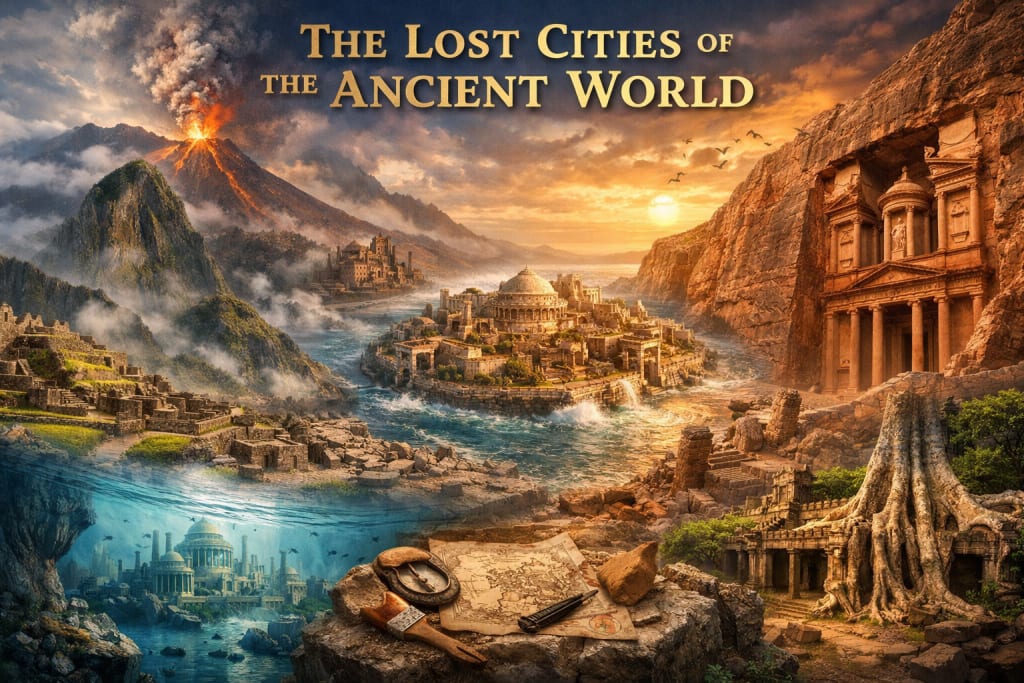
Across deserts, jungles, mountains, and beneath the sea, the earth keeps secrets. Entire civilizations once thrived in places that today stand silent — swallowed by sand, reclaimed by forests, shattered by earthquakes, or simply forgotten by history. The lost cities of the ancient world are more than ruins; they are reminders of humanity’s ambition, brilliance, and fragility.
Some were destroyed by natural disasters. Others collapsed under war, famine, or political decline. Many faded gradually, abandoned as trade routes shifted or empires fell. Yet each one tells a story — not just of how it ended, but of how it once flourished.
Let’s journey into some of history’s most fascinating lost cities and uncover what they reveal about us.
Machu Picchu – The City in the Clouds
High in the Andes Mountains of Peru lies Machu Picchu, a breathtaking Incan citadel built in the 15th century. Hidden among mist-covered peaks, it remained unknown to the outside world until 1911 when American historian Hiram Bingham brought it international attention.
Believed to have been a royal estate or sacred religious site, Machu Picchu showcases advanced Incan engineering. Massive stones fit together without mortar, resistant to earthquakes even today. Terraced agriculture sustained its residents, while its strategic location provided natural defense.
Yet, for centuries, it stood abandoned. The Spanish conquistadors never found it. The reasons for its desertion remain debated — disease, political instability, or the fall of the Incan Empire may have played a role.
Machu Picchu teaches us that even the most sophisticated societies can vanish, leaving behind only stone and sky.
Petra – The Rose-Red City
Carved directly into pink sandstone cliffs in modern-day Jordan, Petra was once the thriving capital of the Nabataean Kingdom around the 4th century BCE. Its elaborate tombs and temples, including the iconic Treasury (Al-Khazneh), demonstrate extraordinary architectural skill.
Petra prospered as a trade hub connecting Arabia, Egypt, and the Mediterranean. Caravans carrying spices, silk, and incense passed through its narrow canyon entrance known as the Siq.
But changing trade routes and devastating earthquakes weakened the city. By the medieval period, Petra was largely forgotten by the Western world until rediscovered in 1812.
Petra reminds us that economic power often determines survival. When trade shifted, the city’s lifeline disappeared.
Pompeii – Frozen in Time
In 79 CE, Mount Vesuvius erupted with catastrophic force, burying the Roman city of Pompeii under ash and pumice. Within hours, life as its citizens knew it ended.
Unlike many lost cities that slowly faded, Pompeii was preserved in tragic detail. Buildings, mosaics, graffiti, and even the casts of victims remain intact. Archaeologists have gained unparalleled insight into daily Roman life because of this disaster.
Pompeii stands as a haunting reminder of nature’s power. Prosperity, art, and culture can disappear in a single day.
Angkor – The Jungle Empire
At its height between the 9th and 15th centuries, Angkor was one of the largest cities in the world. Built by the Khmer Empire in present-day Cambodia, it featured vast temple complexes, reservoirs, and urban planning far ahead of its time.
The most famous temple, Angkor Wat, remains a symbol of Cambodia today. However, climate changes, overextended infrastructure, and political conflict contributed to Angkor’s gradual decline.
Over centuries, thick jungle enveloped the city, hiding it from view. When European explorers encountered it in the 19th century, they were astonished by its scale.
Angkor shows that even great engineering feats cannot always withstand environmental change.
Atlantis – Myth or Memory?
Perhaps the most famous lost city of all, Atlantis exists in the realm of legend. First described by the Greek philosopher Plato, Atlantis was said to be a powerful island civilization that sank into the ocean in a single day and night.
Scholars debate whether Atlantis was purely allegorical — a moral lesson about hubris — or inspired by real events such as volcanic eruptions or ancient disasters.
While no definitive evidence confirms its existence, the idea of Atlantis captivates imaginations worldwide. It represents humanity’s fascination with what might lie beneath the surface — literally and metaphorically.
Why Do Cities Disappear?
Lost cities rarely vanish without reason. Their downfall typically follows patterns:
Natural Disasters – Earthquakes, volcanic eruptions, floods, and droughts can devastate urban centers.
Economic Shifts – Trade routes change, resources dry up, industries collapse.
War and Invasion – Conquest can destroy infrastructure and scatter populations.
Environmental Degradation – Deforestation, soil depletion, and water mismanagement weaken sustainability.
Political Instability – Internal conflict can erode social cohesion.
What’s striking is how modern societies face similar vulnerabilities. Climate change, economic dependency, and geopolitical tension echo the challenges of the past.
The Role of Archaeology
Archaeology acts as a bridge between silence and story. Through excavation, satellite imagery, and technological innovation like LiDAR scanning, researchers continue uncovering hidden cities beneath forests and deserts.
Recent discoveries in the Amazon and Central America suggest that ancient civilizations were more complex and widespread than previously believed. Each new finding reshapes our understanding of history.
Lost cities are not merely relics — they are evolving conversations between past and present.
What Lost Cities Teach Us
The ruins whisper important lessons:
No civilization is invincible.
Adaptation determines survival.
Nature always has the final word.
Human creativity endures beyond collapse.
Despite their fall, these cities continue influencing culture, tourism, research, and imagination. Their stones still stand. Their stories still matter.
A Reflection on Impermanence
There’s something deeply human about our fascination with lost cities. Perhaps it’s because they mirror our own fragility. We build skyscrapers and digital empires, believing they will last forever — yet history suggests otherwise.
The ancient world reminds us that permanence is an illusion. Civilizations rise, flourish, and fall. What remains are traces — art, architecture, memory.
And maybe that’s enough.
The lost cities of the ancient world are not just about the past. They are warnings. They are inspiration. They are evidence that humanity has always dared to build magnificently — even knowing that time eventually reclaims everything.
In the end, lost cities are not truly lost. They are waiting — beneath sand, beneath vines, beneath waves — ready to tell their stories again.
About the Creator
Keep reading
More stories from Aiman Shahid and writers in Confessions and other communities.
The Version of Me They Never Knew
There is a version of me that most people never met. She is louder. Softer. Braver. More opinionated. Less apologetic. She laughs without checking who is watching. She says “no” without explaining herself three different ways. She dreams without first calculating who might be uncomfortable with her ambition.
By Aiman Shahid2 days ago in Confessions
Blessed 33
So I woke up on the morning of February 5, 2026 and guess what and you know what I realized? It’s my 33rd birthday. Do you know what that means? Yes, technically I’m getting old, but what I couldn’t have guessed was this would be one of the best days of my life.
By Joe Patterson18 days ago in Confessions




Comments
There are no comments for this story
Be the first to respond and start the conversation.