
A Survivor’s Final Stand: How One Woman Helped Convict Her Killer
Judy Malinowski survived cancer, was burned by boyfriend Michael Slager recorded testimony before dying, and helped secure his life sentence, becoming the first deceased victim to testify in court ever.
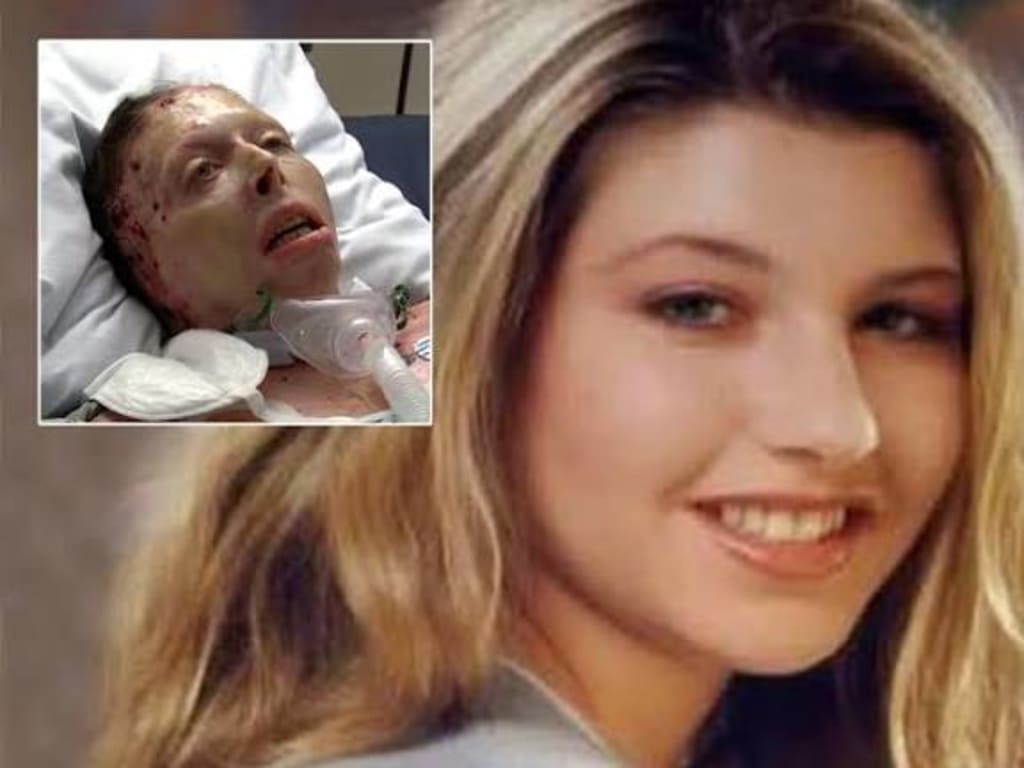
The story of judy Malinowski is one of devastating violence personal resilience and an extraordinary fight to ensure accountability after unimaginable suffering.Judy was a young woman from Columbus, Ohio whose life, like many others was shaped by circumstances that slowly placed her in harm’s way. She had survived cancer and, during her treatment and recovery, was prescribed powerful painkillers. Over time, she became dependent on them. When her medical insurance later expired, her access to proper care and legal medication disappeared. Without the support she needed to manage both her pain and her growing addiction, she eventually turned to heroin.
At the center of this period in her life was her boyfriend, Michael Slager .Rather than helping her escape addiction Slager exploited it. He supplied her with heroin and used the drug as a tool of control. Judy later described how her dependence made it nearly impossible to leave the relationship. Addiction, isolation, and manipulation trapped her in a cycle of fear and reliance that would ultimately place her in extreme danger.
On August 2, 2015, that danger became a brutal reality. Judy and Slager were arguing at a service station when the situation suddenly escalated into horrific violence. During the confrontation, Slager poured fuel on Judy and set her on fire. The attack left her with burns covering roughly 90 percent of her body. She was only 31 years old.
Against staggering odds, Judy survived the initial attack. Her injuries were catastrophic and required extensive, ongoing medical treatment. Her recovery involved multiple surgeries, constant pain, and the permanent physical effects of severe burns. Even so, her resolve remained intact. She was determined to live long enough to see justice done for what had been done to her.
In 2016, Slager was sentenced to 11 years in prison for aggravated arson. For many victims, such a sentence might have marked the end of the legal process. For Judy, it felt deeply inadequate. She believed the punishment did not reflect the intent or the cruelty of the attack, nor the fact that she had been deliberately set on fire and left fighting for her life.
Judy understood that her health was deteriorating. The long-term complications of her injuries made it clear that her future was uncertain. Rather than retreat from the legal process, she made a remarkable decision: she chose to record a detailed video testimony describing the attack, her relationship with Slager, and the suffering she endured. She did so with full awareness that she might not live to see the next stage of the case. Her goal was simple and powerful—to make sure her voice would still be heard.
The recording was not merely a statement. It was a deliberate act of courage and preparation. Judy wanted the court to hear directly from her, even if she could not physically be present. She spoke about the control Slager exerted over her through drugs, the events leading up to the attack, and the moment her life was forever changed. In doing so, she transformed her personal tragedy into testimony that could not be silenced by time or illness.
In June 2017, Judy Malinowski passed away as a result of complications stemming from her injuries. Her death marked a devastating end to a long and painful struggle for survival. But it also changed the course of the legal case.
Following her death, Slager was charged with murder. During the trial, Judy’s recorded testimony was played in court. The impact of her words was profound. For the first time in a U.S. courtroom, a deceased victim’s own testimony was presented to a jury in a murder trial. Her voice, preserved on video, became central to the case.
The jury ultimately found Slager guilty of murder. He was sentenced to life in prison.
Judy’s case became historically significant not only because of the verdict, but because it challenged long-standing assumptions about whose voices can be heard in court. Her determination to record her testimony ensured that the person most affected by the crime remained at the center of the trial, even after her death.More than a story of violence, Judy Malinowski’s legacy is a story of agency. Despite severe trauma, addiction, and life-threatening injuries, she took control of how her story would be told. Her decision to preserve her testimony changed the outcome of her case and opened new conversations about justice for victims who may not live to see their day in court.
About the Creator
Keep reading
More stories from Kure Garba and writers in Criminal and other communities.
The Brutal Killing of Hollywood Model Iana Kasian
In May 2016 a shocking and deeply disturbing crime unfolded in Los Angeles, leaving the local community and the wider public grappling with the brutal death of 30-year-old model Iana Kasian Kasian lived in a Hollywood-area home with her fiancé, graphic novelist Blake Leibel who would later be identified as her killer.Kasian’s body was discovered inside the couple’s residence in Los Angeles after her mother, who had been unable to reach her, contacted authorities and requested a welfare check. When officers arrived at the property, they encountered a scene that prosecutors would later describe as exceptionally violent. Leibel was present at the home and was taken into custody at the scene.
By Kure Garba3 days ago in Criminal
Epstein Files: Story Explained
This is the infamous private island known as Little Saint James, often called “Epstein Island.” Spread across 72 acres, the island had nearly every luxury imaginable — from lavish resorts and private docks to a library and even a cinema. Some of the world’s most powerful figures frequently visited.
By Imran Ali Shah3 days ago in Criminal



Comments
There are no comments for this story
Be the first to respond and start the conversation.