
Completed Draft
vs. Completed Work

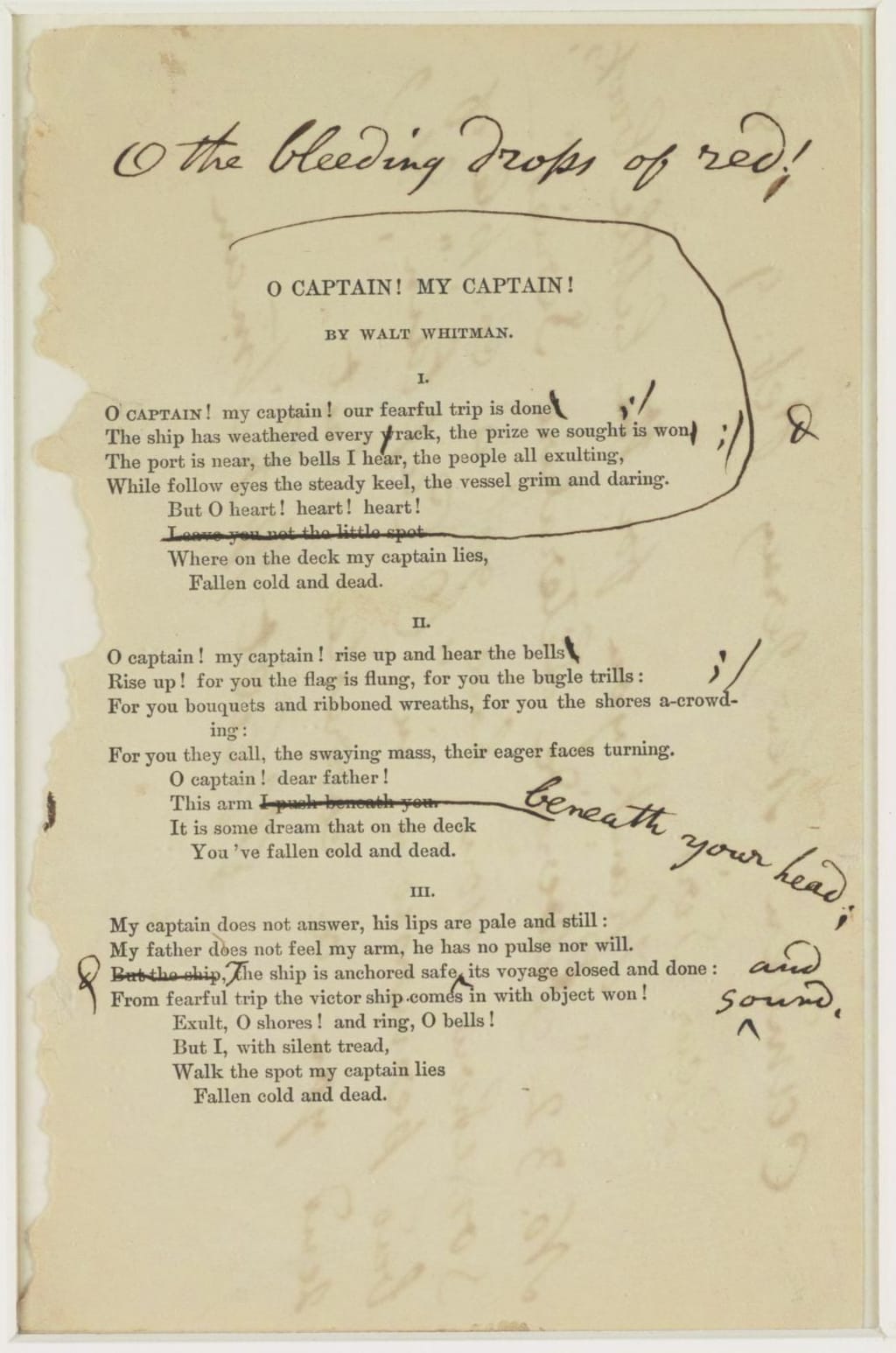
When is a piece of writing finished? It’s a question with as many different answers as writers. For me, a work is finished when it can’t be improved anymore. Almost everything I have posted here is still in drafting (not draft; they’re posted). Even when I think a work is finished, I read it again, usually finding something I can improve or tighten.
My writing professors speak to me while I’m writing, and during the first few revisions. When I move to editing, my Anglo-Saxon/medieval literature professor, who was also my linguistics professor, starts talking to me about my phonemes, and that’s when the real work starts, especially in poetry.
I have many different poetic moods, and I’m not afraid to try different styles, different voices, different narrators, or different forms, but in the end, in poetry, it comes down to language, sound, and meaning. Sound does not exclusively belong to rhyme, though it attempts to monopolize it, often exploiting it in the process.
Many defend rhyme as a basic element of poetry, and that’s my problem with it—it’s too easy to create counterproductive rhyme, and if rhyme knowledge is the end of prosody education, the work will suffer and never reach its full potential. I want to see other devices at work: give me metonymy, synecdoche, assonance, consonance, alliterate important ideas. Bring me some intertextuality, and I’m putty in your hands. I put effort into rhyme prevention: it’s the literary equivalent of glitter. It sparkles and distracts, gets all over everything, and once you’ve been exposed, it’s nearly impossible to get rid of it.
The first step to becoming a poet is learning your prosody terms (yes, it’s ironic that terms for poetry are referred to as prosody while the study of prose is poetics). Knowledge of prosody improves your work, informs you of device beyond rhyme. You’re on a playing field with formally trained writers who have internalized this information, and skillful use of device is rewarded. Talent isn’t enough by itself; craft matters. Execution requires knowledge.
Let’s pause for a moment and give formal training the respect it deserves. Linguistics was the most difficult course I’ve ever taken; it’s the science of sound and language, and I worked hard for what I learned in that class. I paid in time, effort, scansion, phoneme labeling, and oh, dear God, the headaches. I rarely left Dr. Fanning’s class without a headache from learning so much in a short period of time.
Presumably, everyone here is talented. Formal training by itself isn’t everything and can never compensate for talent, but talent that hasn’t had the benefit of formal training need not be untrained. Poetry is a serious thing, and serious poetry requires study.
Serious poems win. Each winning piece can be explicated. If you think your piece is strong, instead of insisting, “This should have won,” ask yourself, “What can I learn from this?” and “How can I improve?” Here’s a secret: you can go back and edit anything, as many times as you want until the challenge closes. If it doesn’t win, place, or show, that restriction lifts when the results are posted. Don’t be afraid to edit, to look at each word (especially in poetry and short stories) and ask if it is necessary and whether or not another word would be better. Are there sound clusters that communicate heaviness, sharpness, sinister intentions if the work calls for it? If so, use them. Don’t be afraid to sacrifice a rhyme scheme for a better poem. Keep drafting. A completed draft is not a completed work.
About the Creator
Harper Lewis
I'm a weirdo nerd who’s extremely subversive. I like rocks, incense, and witchy stuff. Intrusive rhyme bothers me. Some of my fiction might have provoked divorce proceedings in another state.😈
MA English literature, College of Charleston
Keep reading
More stories from Harper Lewis and writers in Critique and other communities.
50 CENT VS JIM JONES 50 Cent Orders Jim Jones To Fix Every Door He Kicked In By Monday After Buying The Property… Drops More Footage
It’s not pretty, and it’s actually pathetic. Rapper Jim Jones kicked in the doors to his landlord showing that he covered the $$80,000-$180,000 with a $200,000 deposit. Now, this only fuels the feud between 50 Cent and Jimmy. Fifty’s pettiness goes to new levels as he claims friendship with the building owner Sam. Despite these allegations, the Queens rapper has shown himself to be a master troll of the Internet.
By Skyler Saunders5 days ago in Critique




Comments (3)
solid insights. thank you so much for writing this, i always learn so much from you. your formal training is absolutely invaluable, and i appreciate you sharing. i also feel the work isn't finished until it can't be improved anymore, which often leaves me feeling my work is never finished. i always return to pieces after a time to improve them, sometimes even years later. vocal has sort of turned into my drafting space in a way. i feel nearly completely diminished pressure publishing on here and trying things out. if/when the time comes for it to be elsewhere, i simply delete the piece from vocal so it might find its new home.
Thanks for the lesson and advice. The first poem I ever wrote when I was 14 or 15, was not a rhyming one. It was just thoughts on a page. When done correctly, rhymes can evoke just as much depth and emotion as non-rhyming. But I do so what you mean and see why some poets never go that route. I usually reserve rhymes for something humorous, and vocal rarely choses rhyming poetry as winners. But lately, a few accomplished what they set out to do and won prizes as a result. So yeah, it can be done right. Since I've been on here, I think they've only had one challenge that strictly called for rhyming poetry. Maybe two. Not including the Limerick challenge. Nice Article, Harper. Now, time to go look up Metonym and Synecdoche, haha.
"Best advice on writing I've ever received. Finish." — Peter Mayle