
Why Planets Follow a Narrow Path Across the Sky
If you observe the night sky carefully over weeks or months, you’ll notice something fascinating: the planets do not wander randomly among the stars. Instead, they follow a narrow, predictable path across the sky. This path is known as the ecliptic, and it explains why planets appear in the same general region of the sky year after year.

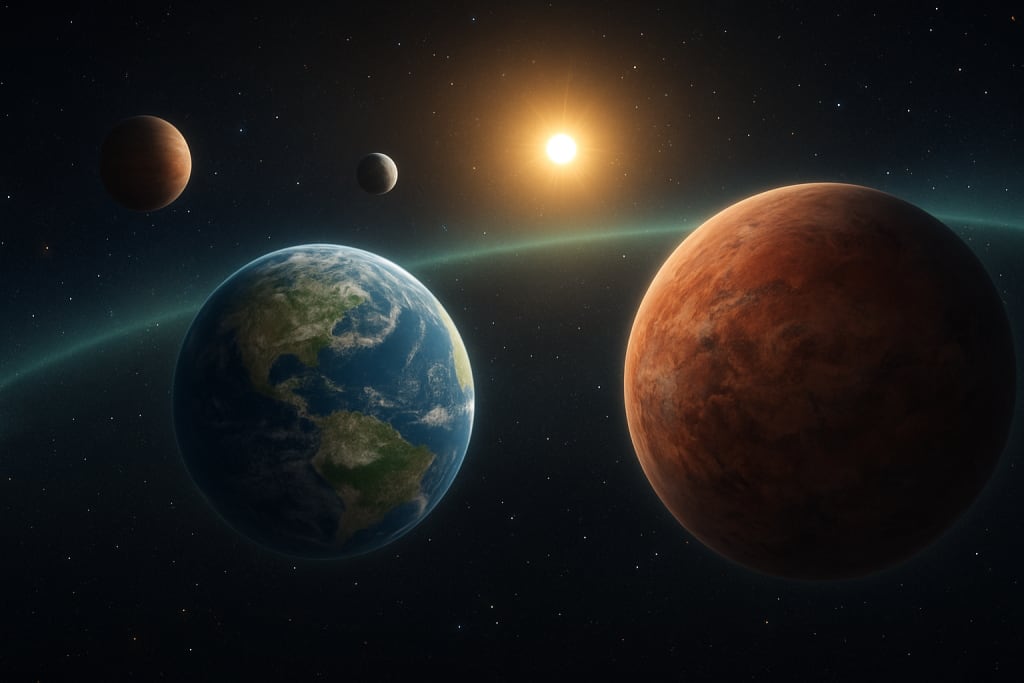
we’ll explore the science behind planetary motion, orbital alignment, and how our view from Earth shapes what we see.
________________________________________
The Solar System’s Flat Design
The key reason planets follow a narrow path lies in how the Solar System formed.
About 4.6 billion years ago, the Solar System began as a massive rotating cloud of gas and dust. Gravity caused this cloud to collapse inward, and as it spun faster, it flattened into a disk shape. The Sun formed at the center, while the planets formed from material within this rotating disk.
Because they formed from the same flattened disk:
• All major planets orbit in nearly the same plane.
• Their orbital paths are aligned closely with one another.
• The Solar System resembles a flat pancake rather than a sphere.
This shared orbital plane is the main reason planets appear confined to a narrow strip of sky.
________________________________________
What Is the Ecliptic?
The ecliptic is the apparent path the Sun takes across the sky over the course of a year. But in reality, it reflects Earth’s orbit around the Sun.
Since the planets orbit the Sun in nearly the same plane as Earth, they appear close to this same path in the sky.
To visualize the structure of the Solar System, consider this orbital relationship:
F=G(m1m2)/r2F = G(m1m2)/r^2F=G(m1m2)/r2
This is Newton’s Law of Gravitation. It explains how gravity keeps planets in orbit around the Sun. Because this gravitational force acts within the flattened disk of the Solar System, planetary motion remains confined to that same plane.
As a result, when we look at the sky from Earth, planets appear to move along a narrow band aligned with the ecliptic.
________________________________________
The Zodiac Constellations and Planetary Motion
The narrow path followed by the planets passes through a set of constellations known as the zodiac. These constellations lie along the ecliptic.
Some well-known zodiac constellations include:
• Aries
• Taurus
• Leo
• Scorpius
Because the planets stay close to the ecliptic, they are always seen within or near these constellations.
Ancient astronomers noticed this pattern thousands of years ago. Civilizations in Babylonia and Greece carefully tracked planetary movements along this narrow path, leading to early models of the cosmos.
________________________________________
Why Don’t Planets Drift All Over the Sky?
It may seem logical to assume planets could move anywhere in the sky, but two major reasons prevent that:
1. Shared Orbital Plane
Since planets formed in the same rotating disk, their orbits are tilted only slightly relative to Earth’s orbit. Most planetary orbital inclinations differ by just a few degrees.
For example:
• Mercury has an orbital tilt of about 7 degrees.
• Mars is tilted by about 1.85 degrees.
These small tilts keep planets close to the ecliptic rather than scattered across the sky.
________________________________________
2. Earth’s Viewing Perspective
From Earth, we observe the sky as a giant dome. Even though planets orbit in three-dimensional space, our position inside the Solar System flattens our perspective.
Imagine looking at coins spinning on a flat table from a low angle. They would appear to move along a thin line rather than across the entire room.
Similarly, Earth’s position within the orbital plane makes planetary motion appear confined to a narrow celestial highway.
________________________________________
Retrograde Motion: A Temporary Illusion
Sometimes planets appear to move backward temporarily. This phenomenon is called retrograde motion.
Retrograde motion occurs when Earth overtakes another planet in its orbit. The apparent backward movement is simply a perspective effect.
Despite this temporary reversal, planets still remain near the same narrow path in the sky.
For example, Jupiter regularly undergoes retrograde motion, yet it never strays far from the zodiac constellations.
________________________________________
Orbital Mechanics and Predictability
Planetary motion follows precise physical laws. One of the foundational principles describing orbiting motion is centripetal force balancing gravity:
F=mv2/rF = mv^2/rF=mv2/r
This equation shows how the motion of a planet (mass m, velocity v) curves around the Sun due to gravitational force.
Because this motion occurs within the same general orbital plane, the result is a stable, repeating path that we observe as the ecliptic.
________________________________________
Why the Moon and Sun Follow Similar Paths
The Moon also appears close to the ecliptic because it orbits Earth in nearly the same plane as Earth’s orbit around the Sun.
The Sun defines the ecliptic itself.
This is why solar and lunar eclipses only occur when the Moon crosses the ecliptic plane. Everything aligns along this narrow celestial corridor.
________________________________________
The Tilt of Earth’s Axis and the Celestial Equator
Earth’s axis is tilted by about 23.5 degrees. This tilt creates another imaginary line in the sky called the celestial equator.
To understand axial tilt mathematically:
sin(theta)=opposite/hypotenusesin(theta) = opposite/hypotenusesin(theta)=opposite/hypotenuse
While simple, trigonometry helps astronomers calculate the apparent angle between the ecliptic and celestial equator.
The ecliptic and celestial equator intersect at two points called the equinoxes. These intersections are crucial for calendars and seasonal tracking.
________________________________________
Historical Importance of the Narrow Planetary Path
The predictable planetary path shaped early astronomy and navigation.
Ancient astronomers tracked planets along the zodiac to:
• Predict seasons
• Develop calendars
• Navigate long distances
• Create early cosmological models
For example, the geocentric model developed by Claudius Ptolemy attempted to explain planetary motion within this narrow band of sky.
Later, the heliocentric model proposed by Nicolaus Copernicus correctly explained why planets follow the same path — they orbit the Sun in a shared plane.
________________________________________
Do All Planets Follow the Path Exactly?
Not perfectly — but very closely.
Each planet has a slightly different orbital inclination. Over time, gravitational interactions can cause minor shifts. However, these changes are small enough that planets remain confined to a band only about 8 degrees wide on either side of the ecliptic.
This is extremely narrow compared to the full 360-degree dome of the sky.
________________________________________
What Would Happen If Orbits Were Random?
If planets orbited in wildly different planes:
• They would appear scattered throughout the sky.
• Zodiac constellations would not exist as a concept.
• Predicting planetary positions would be far more complex.
• Eclipses would be extremely rare or chaotic.
The orderly sky we observe today is a direct result of the Solar System’s flat formation.
________________________________________
Modern Space Exploration Confirms the Disk Structure
Space missions and telescopes have confirmed that planetary orbits align within a thin plane.
Images from spacecraft studying Saturn and Neptune show that even distant planets remain close to the same orbital plane.
Additionally, observations of other star systems reveal protoplanetary disks — flattened structures where planets are forming. This confirms that our Solar System’s layout is not unique but follows a common cosmic pattern.
________________________________________
Why This Matters for Astronomy and Astrophysics
Understanding why planets follow a narrow path helps scientists:
• Predict planetary positions
• Plan spacecraft trajectories
• Search for exoplanets
• Understand planetary system formation
It also explains why planetary alignments occur and why conjunctions happen along the ecliptic.
________________________________________
Conclusion: The Cosmic Highway Above Us
Planets follow a narrow path across the sky because they were born in a flattened rotating disk and continue to orbit the Sun in nearly the same plane. From Earth’s perspective, this shared orbital alignment creates the ecliptic — a celestial highway through the zodiac constellations.
Governed by gravity and orbital mechanics, planetary motion is both predictable and elegant. The narrow band we observe is not a coincidence but the natural outcome of cosmic formation processes that began billions of years ago.
The next time you spot a bright planet shining near a zodiac constellation, remember: you are witnessing the grand design of a flattened Solar System in motion — a precise and beautiful dance along a narrow path written by gravity itself.
About the Creator
Keep reading
More stories from shahkar jalal and writers in Education and other communities.
How the Moon Stabilizes Earth’s Sky View: The Hidden Guardian of Our Planet
Understanding Earth’s Axial Tilt and Rotation Earth spins on an imaginary line called its axis. This axis is tilted at approximately 23.5 degrees relative to its orbit around the Sun. This tilt is responsible for the changing seasons as different parts of the planet receive varying amounts of sunlight throughout the year.
By shahkar jalal31 minutes ago in Education
Ramadan Mubarak – A Month of Mercy, Forgiveness, and Spiritual Transformation
Ramadan is not just a month in the Islamic calendar — it is a divine season of mercy, forgiveness, and spiritual elevation. It is the month in which Allah Almighty revealed the Noble Qur’an as guidance for humanity, a criterion between truth and falsehood, and a light for those who seek righteousness.
By M Irfan Zafar7 days ago in Education
The First UK Baby Born from a Deceased Donor’s Uterus
In a historic medical breakthrough, a baby boy named Hugo was born in the United Kingdom just days before Christmas 2025, weighing 7 pounds and making global headlines. His birth was not only a moment of joy for his family but also a landmark achievement in modern medicine. Hugo is the first baby in the UK to be born using a uterus transplanted from a deceased donor, marking a new era in reproductive science and offering hope to millions of women around the world.
By Irshad Abbasi about 4 hours ago in Education
Belle of the Bayou
Bad move, cher. Not just the slip of her kitten heel on the rainy February cobblestones in the Fourth Ward. She got caught snooping. Detective Deleon clucked and strutted like a rooster in his rush to clear her from the scene, waving cigar smoke to and fro as he gesticulated amid the thick air of the speak easy. An experienced crime reporter, Marie knew better than to let the coppers catch her on the wrong side of the line, but curiosity had gotten the better of her.
By Maia Gadwall the metAlchemist3 days ago in Fiction




Comments
There are no comments for this story
Be the first to respond and start the conversation.