
Head Space / Body Space / Shared Space
Where perception becomes structure — and structure becomes culture.

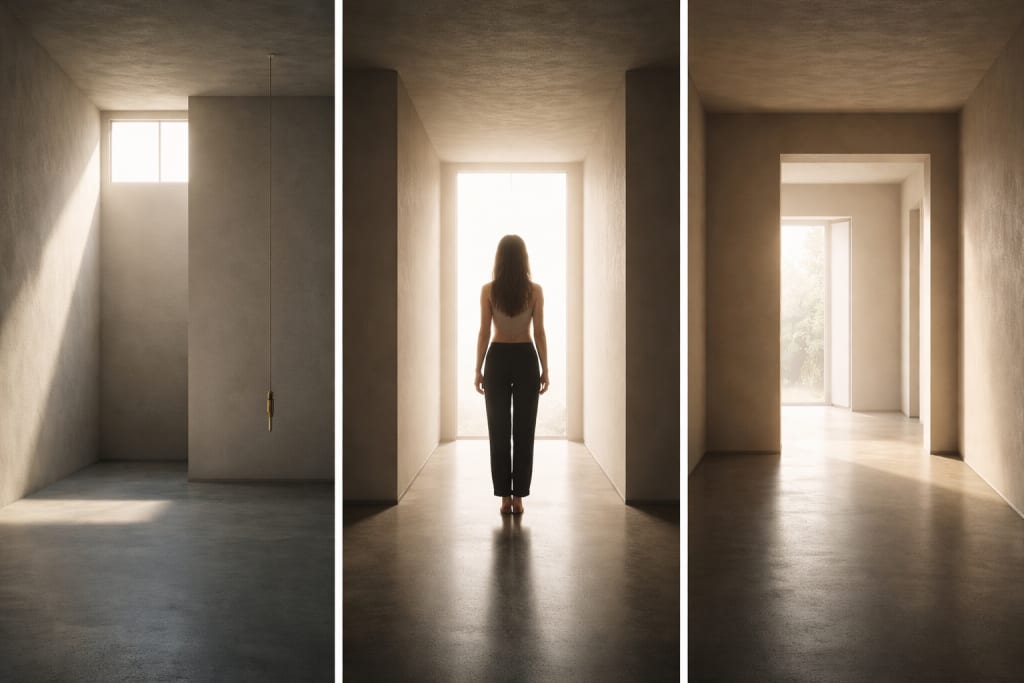
🔹 Series Introduction
We do not live inside circumstances.
We live inside structures.
This trilogy explores the architecture of perception — how head spaces shape body spaces, and how both silently construct the shared environments we call relationships, rooms, and culture. Alignment is not intensity. It is design.
When internal architecture stabilizes, shared space changes.
The Architecture of Head Spaces
Where perception becomes structure
There are rooms inside the mind.
Some are bright and ventilated.
Some are crowded with old voices.
Some are still carrying conversations that ended years ago.
A head space is not just a mood.
It is a constructed environment.
It is the internal architecture built from repetition:
the thoughts we rehearsed,
the beliefs we inherited,
the fears we practiced,
the stories we never questioned.
And like any architecture, it influences behavior.
When the head space is tight, the body tightens.
When the head space scans for threat, the nervous system prepares for battle.
When the head space rehearses guilt, responsibility becomes distortion.
Most people try to change their behavior
without ever examining the room they’re standing in.
But behavior follows structure.
If the internal room says:
“It’s my responsibility.”
“It will be my fault.”
“I should be stronger.”
“I cannot let someone suffer.”
Then the body obeys that architecture —
even when it hurts.
Head spaces can feel invisible because we live inside them.
But they leave traces:
- The breath shortens.
- The jaw locks.
- The shoulders rise.
- The thoughts loop.
- The body forgets it is supported.
The shift does not begin with force.
It begins with noticing.
Noticing:
“I am in a pressure room.”
“I am in a guilt room.”
“I am in a scanning room.”
“I am in a performance room.”
Awareness creates ventilation.
A regulated head space feels different.
It is not empty.
It is steady.
There is space between thought and reaction.
There is weight in the chair.
There is breath without effort.
There is perception without urgency.
In that space, responsibility becomes choice.
Care becomes discernment.
Compassion does not require collapse.
The Lioness does not eliminate rooms.
She rebuilds them.
She removes inherited beams.
She redraws internal walls.
She widens windows.
She installs grounding.
And slowly, the architecture changes.
A healthy head space is not positive thinking.
It is structural alignment.
It is knowing:
I can care without carrying.
I can observe without absorbing.
I can remain vertical inside my own mind.
Head spaces are not destiny.
They are design.
And design can be revised.
The Architecture of Body Spaces
Where stored memory becomes sensation
The body is not separate from the head space.
It is the echo chamber.
Every repeated thought leaves residue.
Every prolonged stress leaves imprint.
Every unspoken boundary leaves tension somewhere.
The body keeps score — not as punishment,
but as preservation.
A body space is the physical landscape shaped by internal architecture.
Tight hips can hold unexpressed defense.
A buzzing chest can hold urgency.
A numb lower back can hold over-responsibility.
A clenched jaw can hold unspoken words.
The body does not lie.
It signals.
But most people override the signal
because they were trained to override themselves.
When the head space says,
“Stay strong.”
The body absorbs.
When the head space says,
“It’s my responsibility.”
The nervous system mobilizes.
When the head space scans rooms,
the body becomes a radar system.
Eventually, the body space becomes conditioned.
It prepares before danger appears.
It braces before conflict begins.
It tightens before someone even speaks.
The shift begins the same way it did in the mind:
Noticing.
Noticing:
“My breath just shortened.”
“My hips just locked.”
“My chest is buzzing.”
“My body is preparing for something that hasn’t happened.”
Regulation is not collapse.
It is recalibration.
When the body space is regulated, it feels different:
The chair holds your weight.
The floor meets your feet.
Your breath moves without instruction.
Your spine lengthens without force.
You are not abandoning responsibility.
You are releasing false load.
The Lioness does not dominate her body.
She inhabits it.
She listens before she reacts.
She softens before she hardens.
She stabilizes before she responds.
A healthy body space is not tension-free.
It is responsive without distortion.
It does not brace for imagined storms.
It stands steady in real ones.
The body is not the problem.
It is the messenger.
And when the head space changes,
the body space follows.
The Architecture of Shared Spaces
Where individual structure becomes collective climate
Shared spaces are built from the head and body spaces of everyone inside them.
A room full of scanning nervous systems
feels different than a room full of regulated ones.
A partnership built on guilt
feels different than one built on choice.
A family structured around emotional dumping
feels different than one structured around reciprocity.
Shared spaces amplify internal architecture.
If you abandon yourself in your head space,
you will abandon yourself in shared space.
If your body braces automatically,
the relationship will feel like pressure.
Shared spaces reveal what individuals refuse to repair.
You can feel it:
- Conversations that circle without resolution.
- Energy that drains without exchange.
- Responsibility that flows one direction.
- Intensity mistaken for intimacy.
A healthy shared space is not quiet.
It is aligned.
It allows difference without collapse.
It allows boundaries without punishment.
It allows care without consumption.
The Lioness does not fix shared spaces by force.
She adjusts her own architecture.
If she redraws the line, she stands beside it.
If others do not cross, she does not chase.
If the structure cannot hold integrity, she does not shrink to fit it.
Shared space is not sustained by intensity.
It is sustained by coherence.
And coherence begins privately.
Head space.
Body space.
Then shared space.
When these three align,
trust becomes infrastructure.
And infrastructure becomes culture.
🔹 Closing Benediction
May we notice the rooms we stand in.
May we rebuild what no longer holds integrity.
May our internal architecture become steady enough
that shared spaces no longer require self-abandonment.
Coherence is not loud.
It is sustainable.
—Flower InBloom
About the Creator
Flower InBloom
I write from lived truth, where healing meets awareness and spirituality stays grounded in real life. These words are an offering, not instruction — a mirror for those returning to themselves.
— Flower InBloom
Keep reading
More stories from Flower InBloom and writers in Humans and other communities.
The Architecture of Heroism
The Architecture of Heroism Strength Without Spectacle We are taught to recognize heroes by volume — by urgency, by sacrifice, by visible impact. But much of what sustains a life, a family, or a culture is quieter than that. This series explores heroism not as spectacle, but as structure: the steadiness that prevents collapse, the discernment that interrupts harm, and the regulation that builds something lasting. Here, strength is not dramatic. It is disciplined.
By Flower InBlooma day ago in Humans
Past Life Regression Therapy: What to Expect and How to Prepare.
Past life regression therapy attracts people who seek insight into deep emotional patterns, recurring fears, or unexplained connections. You might feel curious, skeptical, or hopeful. All responses are normal.
By Wilson Igbasi7 days ago in Humans



Comments (1)
AMEN