
The Room That Did Not Ask Anything From Me
What it felt like to work in a space that required no adjustment

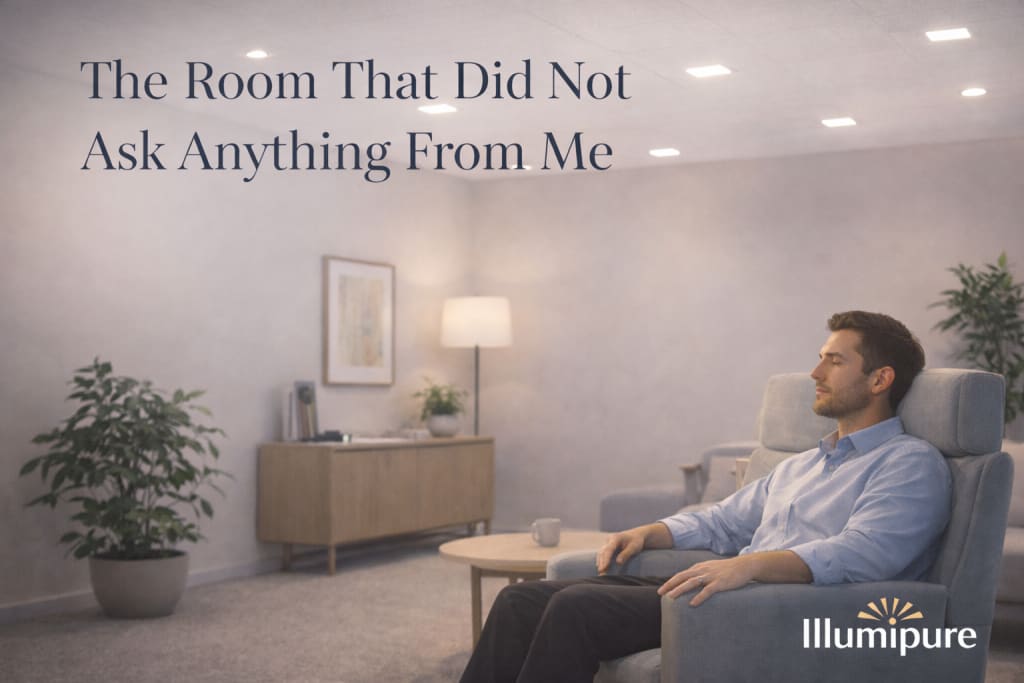
Most rooms ask something from you.
They ask your eyes to adjust.
They ask your shoulders to tighten slightly.
They ask your breathing to compensate.
They ask your nervous system to stay alert.
You rarely notice the request. You simply comply.
For a long time, I thought that was normal. Work required effort, so of course my body felt engaged. Of course I shifted in my chair every so often. Of course my jaw felt slightly tight by mid-afternoon. I assumed that was the cost of focus.
Then I spent a full day in a room that didn’t ask anything from me.
I didn’t recognize the difference immediately. The room wasn’t dramatic. It wasn’t brighter or more visually impressive. It wasn’t filled with plants or elaborate design elements. It was simply steady.
That steadiness was new.
The lighting felt present but not intrusive. There was no glare bouncing off surfaces. No harsh contrast between desk and screen. No subtle flicker pulling at the edges of my vision. My eyes didn’t need to recalibrate every time I looked up or down.
I didn’t squint.
That alone was unusual.
Many indoor lighting systems create micro-adjustments in the visual cortex. Even when flicker is invisible, the brain detects instability and compensates. Pupil size shifts. Eye muscles tighten. Neural processing increases slightly to stabilize the image. These corrections are small, but they are constant.
In this room, they weren’t necessary.
My breathing was the next thing I noticed. Or rather, I noticed that I wasn’t noticing it. In other environments, I often find myself taking deeper breaths throughout the day, as if trying to reset something. A subtle tightness accumulates in the chest without clear cause.
Here, my breathing remained low and natural. The air felt neutral—neither stale nor artificially chilled. It didn’t draw attention to itself.
Carbon dioxide levels, particulate matter, airflow patterns—these variables quietly influence how the body regulates oxygen. Even minor shifts can affect cognitive clarity and muscle tone. When the air is slightly off, the body compensates.
In this room, it didn’t need to.
The most surprising change was in my posture. I wasn’t slouched, but I also wasn’t braced. My shoulders rested against the chair instead of hovering slightly forward. My neck remained long instead of subtly compressed.
I wasn’t holding myself up.
That’s when I realized how often spaces require subtle bracing.
The human nervous system is designed to scan for irregularities. Uneven lighting. Acoustic unpredictability. Subtle environmental instability. When these signals appear, even at low levels, the sympathetic system engages just enough to prepare.
Preparation means tension.
Preparation means readiness.
Preparation means energy expenditure.
Most of the time, we call that “being focused.” But focus does not require vigilance. In fact, sustained cognitive performance improves when vigilance decreases and regulation increases.
In the room that did not ask anything from me, my nervous system felt regulated rather than stimulated.
My thoughts moved smoothly from one task to the next. Interruptions did not feel jarring. My attention felt continuous rather than fragmented. I wasn’t fighting distraction; I simply wasn’t being distracted by the environment itself.
That absence of friction felt unusual.
Hours passed without the typical signals of strain. No rubbing my temples. No shifting in my seat. No subtle impatience rising late in the day. When the afternoon arrived—the time when I usually expect some level of depletion—I remained steady.
Not energized. Not hyper-alert.
Just steady.
The difference wasn’t that the room gave me energy. It was that it didn’t take any.
That distinction reshaped how I think about productivity. We often assume that output requires pushing—more brightness, more stimulation, more momentum. But the body functions best when it is not defending itself against small, cumulative stressors.
A room that asks nothing allows resources to remain available.
Visual systems stay calm. Respiratory rhythms remain efficient. Muscles conserve energy instead of bracing. The parasympathetic nervous system can stay engaged while cognitive functions operate clearly.
The result isn’t excitement. It’s endurance.
By the end of the day, I felt complete instead of depleted. I still had energy left—not because I had done less, but because I had spent less adapting.
That experience changed how I enter spaces now. I pay attention to whether my body subtly tightens or relaxes. Whether my breath shortens or stays low. Whether my eyes strain or settle.
Rooms communicate with the nervous system before we consciously interpret them.
Most rooms ask for something.
Some ask for constant correction.
A rare few ask for nothing at all.
And in those spaces, you realize how much of your energy was previously spent just maintaining equilibrium.
The room that did not ask anything from me did not announce itself. It did not perform. It did not stimulate.
It simply aligned.
And in that alignment, my body no longer had to negotiate.
It could just work.
About the Creator
illumipure
Sharing insights on indoor air quality, sustainable lighting, and healthier built environments. Here to help people understand the science behind cleaner indoor spaces.
Keep reading
More stories from illumipure and writers in Journal and other communities.
How My Energy Lasted Longer Without a Boost
For years, my energy followed a pattern. Morning clarity. Midday focus. Then, sometime in the afternoon, a subtle drop. Not dramatic, but noticeable enough to reach for something—a second coffee, a sugary snack, a quick walk just to wake myself back up.
By illumipurea day ago in Journal
~ Fired ~
— Ai Intrusion ~ Are you Next ~ Is Ai Evolution after your job? — Few workplaces haven't been affected. Ai is in supermarkets, at doctors' offices, and even monitoring farms. I just can't think of anything this machine is not getting into, can you? For instance: Education ~ Law and Tech jobs will one day have a major influence or be taken over by these inanimate machines, with accuracy and vigor. From mechanics' diagnoses to a wide variety of everyday jobs, including fast food workers, with this input having the ability to cut their unnecessary work hours. I'm certain all of us have been touched by this with our short stories and colorful headings, have you? Even comments are very questionable 'Non-Robot' insertions.
By Jay Kantor25 days ago in Journal
It's 2026. Songs Turning 10 This Year
In 2016, we saw the rise of short form videos and what would lead to the birth of TikTok. We cannot forget the Snapchat filters no matter how cringe worthy some of them might have been. It was also the year in which the hit series Stranger Things debuted.
By Jasmine Aguilar4 days ago in Beat




Comments
There are no comments for this story
Be the first to respond and start the conversation.