
How to Avoid Burnout in Remote Jobs
Remote work promises freedom.

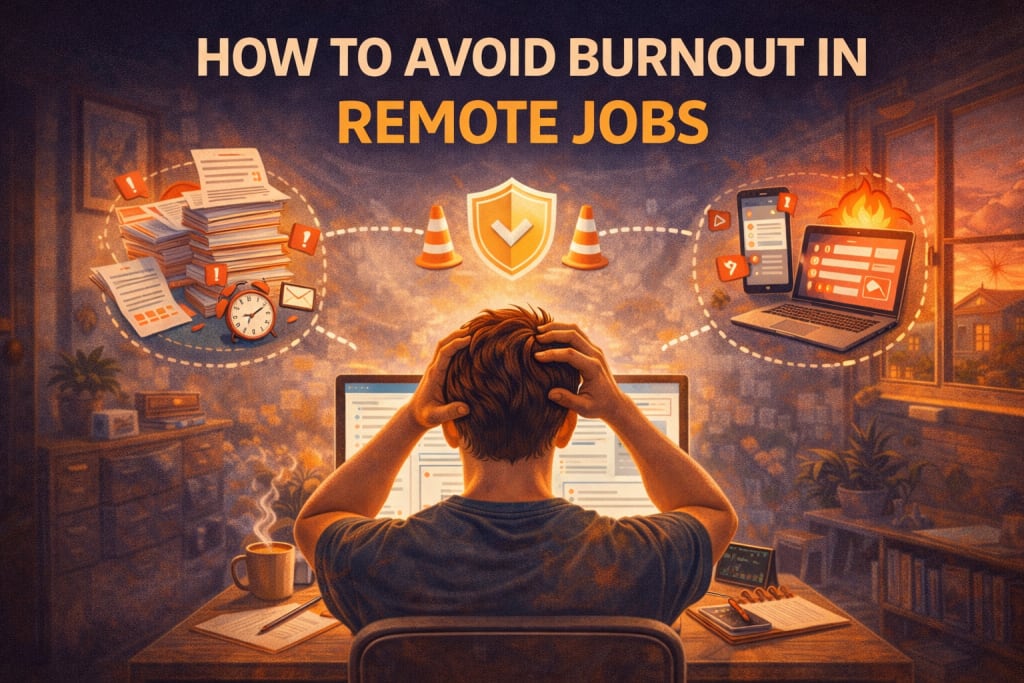
Freedom from commuting.
Freedom from office politics.
Freedom to structure your own day.
But for many remote professionals, that freedom quietly turns into something else — exhaustion.
The truth is, burnout in remote jobs doesn’t happen because people are lazy. It happens because they care too much without protecting themselves.
When your home becomes your office, your brain struggles to separate “work mode” from “life mode.” There’s no commute to decompress. No physical signal that the day is over. Just one more email. One more Slack message. One more task.
And that “one more” slowly becomes too much.
If you want remote work to be sustainable long-term, burnout prevention cannot be accidental. It must be intentional.
Here’s how to protect yourself.
1. Stop Letting Work Expand Into Every Hour
One of the biggest remote work traps is undefined time.
If you don’t clearly set work hours, work will fill every available space.
You check messages at 7 AM.
You respond to emails at 9 PM.
You tell yourself you’re “just staying ahead.”
But in reality, you’re never switching off.
Burnout begins when your nervous system never rests.
Set defined start and end times. Communicate them clearly. When your workday ends, close your laptop and physically walk away.
Boundaries are not laziness. They are sustainability.
2. Create a Physical Separation — Even If It’s Small
You don’t need a luxury home office.
But you do need separation.
Working from your bed or couch feels flexible at first. Over time, it confuses your brain. Your rest space becomes associated with stress. Your mind never fully relaxes.
Even a small desk in the corner of a room can make a difference. When you sit there, you work. When you leave it, you’re done.
Simple psychological signals reduce long-term mental fatigue.
3. Protect Deep Work Like It’s a Meeting
Remote workers often feel pressure to be constantly available. Instant replies. Immediate responses. Always “green” online.
But constant availability destroys focus.
Every notification triggers a stress response. Your brain switches context. Energy drains faster than you realize.
Instead, schedule uninterrupted focus blocks. Turn off non-essential notifications. Batch your communication into specific windows.
High-quality work reduces stress. Constant distraction increases it.
4. Build a Shutdown Ritual
Office workers naturally end their day by leaving the building. Remote workers must create that ending deliberately.
Before logging off:
Review what you completed.
Write down tomorrow’s top priorities.
Close all work tabs.
Shut down your laptop completely.
This ritual signals to your brain that the day is done. Without it, work lingers in the background of your thoughts all evening.
A five-minute shutdown routine can protect hours of mental peace.
5. Manage Energy, Not Just Tasks
Burnout often happens because people try to push through low-energy periods instead of working with their natural rhythm.
Pay attention to when your focus peaks.
If your brain is sharp in the morning, do demanding work then. If your energy dips mid-afternoon, schedule lighter administrative tasks during that window.
Working against your natural energy cycle creates unnecessary strain. Working with it increases productivity and reduces exhaustion.
6. Remember That Hustle Is Not a Long-Term Strategy
Remote work culture sometimes glorifies productivity — early mornings, late nights, side projects, constant optimization.
But sustainability beats intensity.
You don’t need to prove your value by overworking. In fact, consistent, balanced performance is more respected than short bursts of overachievement followed by burnout.
A successful remote career is not built in one intense month. It’s built over years.
7. Protect Your Life Outside Work
This is the part many people ignore.
When you work remotely, your professional identity can quietly consume your entire day. Without commuting or office transitions, work becomes your main activity.
You must actively build life outside of it.
Exercise.
Go outside.
Develop hobbies.
Connect with friends or family.
If your entire world exists inside your laptop, burnout is inevitable.
Remote work should support your life — not replace it.
Final Thought
Burnout in remote jobs isn’t dramatic at first. It’s subtle.
It’s the slow loss of motivation.
The difficulty concentrating.
The feeling of always being “on.”
And by the time you notice it clearly, you’re already exhausted.
The solution is not quitting remote work.
The solution is structure.
Boundaries.
Intentional routines.
Energy management.
And permission to rest.
Remote work can be powerful, freeing, and sustainable.
But only if you treat your energy as your most valuable resource.
Protect it.
Because no opportunity is worth sacrificing your long-term well-being.
About the Creator
Bahati Mulishi
Practical advice on remote work, IT careers, and professional skills to help you stay work-ready anywhere in the world.
Keep reading
More stories from Bahati Mulishi and writers in Lifehack and other communities.
Life Between Doors: The Human Side of Moving in Nashville
Moving is rarely just a logistical task. For most people, it is a profound experience filled with reflection, anticipation, and subtle transformation. In a city like Nashville, where neighborhoods carry rich histories and layers of culture, relocation becomes more than simply moving belongings. It is about carrying memories, navigating change, and embracing a new chapter of life. Every move tells a story, one that blends endings and beginnings, familiarity and the unknown, comfort and adaptation.
By House Doctor7 days ago in Lifehack
The Twenty Minutes I'll Never Get Back (And What They Taught Me About the Internet)
It was a Tuesday. Sometime around nine in the evening. I had been on calls since morning, my desk was a graveyard of sticky notes, and my coffee had gone cold so long ago I'd stopped noticing it.
By adam smith6 days ago in Lifehack




Comments
There are no comments for this story
Be the first to respond and start the conversation.