
The Bridge of Tomorrow
And you raised me to work hard,” Elias replied. “Let me try.”

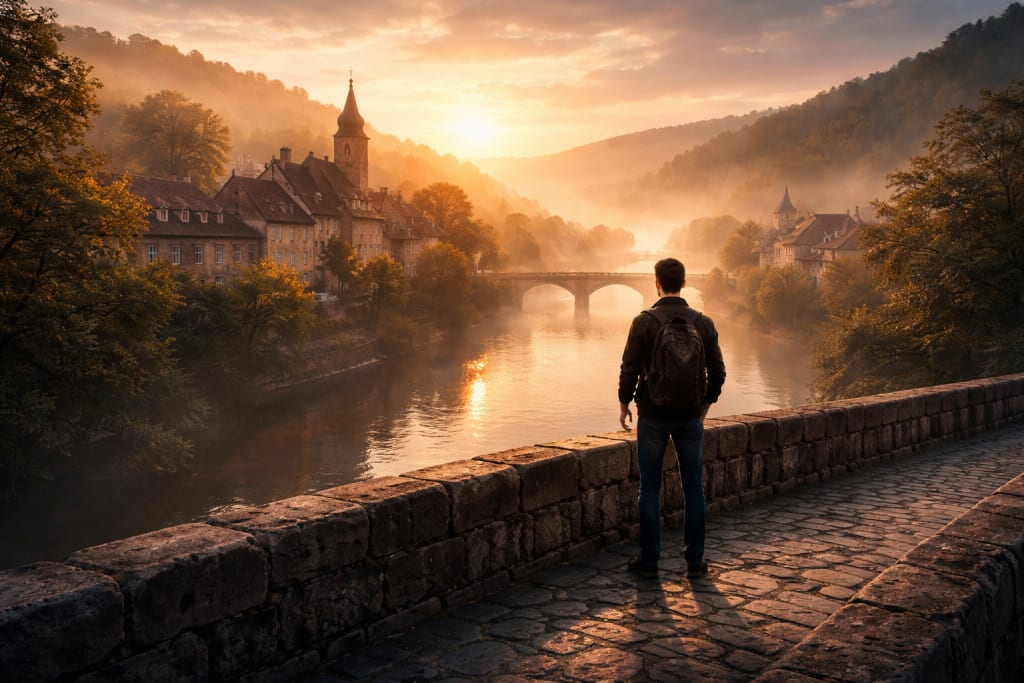
In a small European town tucked between green hills and a quiet river, there lived a young man named Elias. The town was famous for its old stone bridge, built centuries ago. People said the bridge connected not just two sides of the river, but two different futures. One side led toward comfort and routine; the other toward uncertainty and change.
Elias grew up watching his father cross that bridge every morning to work at the same factory, year after year. His mother worked in a nearby bakery, kneading dough before sunrise. Their lives were honest, simple, and predictable. But Elias carried a restlessness inside him, a quiet question that never slept: Is this all there is?
At school, teachers praised Elias for his sharp mind, but also warned him that dreams were expensive. “Be practical,” they said. “Choose safety.” His friends talked about stable jobs and early marriages. No one talked about risk, or failure, or chasing something bigger than the town itself.
One winter evening, while walking home, Elias noticed an elderly woman struggling to cross the bridge with heavy bags. He ran to help her. As they walked slowly across, she looked at him and smiled.
“You walk like someone who wants to go far,” she said.
Elias laughed awkwardly. “I don’t even know where I want to go.”
She nodded. “That’s how every long journey begins.”
The next day, Elias received a letter from a university in another country. He had applied months earlier in secret, never expecting a response. The letter said he had been accepted, but there was a problem—no scholarship, no financial support. His savings were small, and his parents could not afford to help.
That night, Elias sat by his window, watching the moon reflect on the river. Fear whispered to him: You will fail. You will waste time. You will come back with nothing.
But another voice, quieter yet stronger, answered: If you never go, you will always wonder.
When Elias told his parents, silence filled the room. His father stared at the table. His mother’s eyes filled with worry.
“We raised you to be safe,” his father said.
“And you raised me to work hard,” Elias replied. “Let me try.”
They sold an old motorcycle to help him with the first months. The night before he left, Elias stood on the bridge alone. Wind moved through the trees like soft applause. He placed his hand on the cold stone and promised himself one thing: No matter how hard it gets, I will not turn back because of fear.
Life abroad was nothing like the dream. His accent made him feel invisible. His job at a café barely paid the rent. Some days he skipped meals to save money. There were mornings when he thought of home and almost booked a ticket back.
One evening, exhausted after work, Elias saw a street musician playing violin in the metro station. The music was sad and hopeful at the same time. People passed without stopping, but Elias stayed. When the song ended, he dropped his last coins into the musician’s case.
The man looked up and said, “You look tired, friend.”
“I am,” Elias said.
“Then remember,” the musician replied, “even bridges shake when too many people walk on them. But they don’t fall. They were built to hold weight.”
Those words stayed with Elias.
Years passed. He learned the language. He studied at night and worked during the day. Failures came—exams he barely passed, jobs he lost, loneliness that wrapped around him like winter fog. But he kept crossing his own bridge every morning, from doubt to effort, from fear to action.
One spring morning, Elias received an email offering him a position in an engineering company. It wasn’t a miracle; it was the result of thousands of small choices: staying when it was easier to leave, trying when it was safer to stop.
He returned to his hometown one summer, walking again across the old stone bridge. The river looked the same, but he was different. His parents stood waiting for him on the other side. His father hugged him longer than usual. His mother whispered, “You crossed farther than we ever did.”
Elias looked at the bridge and understood something simple but powerful:
Courage is not loud. It does not shout or demand attention. Courage is quiet. It wakes up early. It keeps going when no one is watching.
And maybe that is the lesson of every bridge in every town:
Your future does not begin with certainty.
It begins with a step.
So if you are standing on your own bridge today—between comfort and change, between fear and hope—remember Elias. You do not need to see the whole road. You only need to cross the first stone.
About the Creator
Iazaz hussain
Start writing...
Keep reading
More stories from Iazaz hussain and writers in Motivation and other communities.
The Road Between Two Mornings
In a quiet town tucked between low green hills and a winding river, there lived a young man named Tomas who believed that his life had already chosen him. Every morning at six, he unlocked the wooden door of his uncle’s bakery, tied on a flour-dusted apron, and baked bread for people who rarely looked up from their newspapers. His hands worked quickly, but his thoughts always moved faster—toward places he had never seen and dreams he had never dared to touch.
By Iazaz hussain5 days ago in Motivation
One Hard Thing
Stop me if you’ve heard this one before: You have the number, you know your schedule- you’ve even picked out the perfect day and time to make this appointment. Shoot, you’ve even picked out alternative days and times just in case their schedules can’t accommodate you!
By Taylor Rigsbyabout a month ago in Motivation
Stop Waiting for Permission: The Brutal Truth About Why You’re Stuck in Life
If you’ve ever waited for the “right moment,” “the right sign,” or “someone else’s approval” before taking action — stop scrolling — because that hesitation is silently stealing your life.
By Ahmed aldeabella3 days ago in Motivation


Comments
There are no comments for this story
Be the first to respond and start the conversation.