
Fading Ink
A quiet rediscovery of who we thought we’d be—and who we chose to become
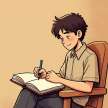

The box was never meant to be opened.
It had lived quietly on the highest shelf of my childhood closet, taped at the corners, labeled in my own looping handwriting: “Important — Do Not Throw Away.” I used to think anything I labeled important would remain that way forever.
Now, standing in my old bedroom at twenty-nine, preparing to sell the house after my mother’s passing, I wasn’t so sure.
Dust drifted in the late afternoon light as I pulled the box down. The tape peeled back with a dry sigh. Inside were journals—five of them—spiral-bound, their covers bent at the edges. Between the pages were folded letters written to no one and everyone at once. To my future self.
The ink had faded to a soft gray.
I sat cross-legged on the floor and opened the first one.
June 3rd, Age 16
By 25, I will have traveled the world. I won’t be afraid of anything. I’ll live in a city with bright lights and never look back. I’ll be someone unforgettable.
I smiled despite myself. The words leaned forward with urgency, pressed hard into the paper as if conviction alone could carve them into reality.
At sixteen, I believed fear was a choice. I believed leaving was the same as becoming.
I turned the page.
I will never settle for a life that feels small.
The house around me creaked in its familiar way. The same floorboards that carried my teenage certainty now held the weight of my hesitation. I had left, yes. I had moved to the city with its impatient traffic and sleepless skyline. I had chased opportunity, measured success in promotions and square footage.
And yet.
I had returned.
The second journal began at nineteen.
I think I’m in love, it read. This must be what forever feels like.
I could almost hear the soundtrack of that year—the dramatic songs, the whispered phone calls past midnight, the certainty that no one had ever felt something so intense.
We had planned everything. An apartment with exposed brick walls. A dog named Atlas. Weekend trips to places neither of us could afford. We spoke about the future like it was a reservation already made.
I flipped forward.
If this ends, I don’t know who I’ll be.
It had ended, of course. Not with betrayal or fire, but with erosion. Tiny disappointments. Different ambitions. Two people walking side by side until the road forked so subtly we didn’t notice until we were already alone.
I remembered thinking heartbreak would ruin me.
It hadn’t.
But it had rewritten me.
The third journal was thinner. Twenty-three.
I am tired, it began.
That startled me. I didn’t remember being tired at twenty-three. I remembered being busy.
Everyone else seems to know where they’re going. I pretend I do. I say yes to everything. I haven’t written in months because I don’t know what I believe anymore.
The handwriting slanted downward, as if even the words were exhausted.
I paused.
At twenty-three, I had thought confusion was failure. That uncertainty meant I was falling behind some invisible schedule. Social media had been a highlight reel of engagements, graduate degrees, startups launched from coffee shops with exposed brick walls.
I measured myself against curated lives.
Reading those pages now, I wanted to reach back through time and loosen my own grip. To tell that version of me that not knowing was not a flaw—it was a doorway.
A folded letter slipped from the last journal. The envelope was unsealed, addressed simply:
To the person I become.
I hesitated before opening it.
I hope you didn’t forget what mattered, it began. I hope you still write. I hope you chose love over pride at least once. I hope you didn’t let fear make your world small. If you’re reading this and you feel disappointed, remember: you are allowed to change your mind. Just don’t stop trying to be brave.
The final line was underlined twice.
Promise me you won’t become someone you don’t recognize.
I let the letter fall into my lap.
Had I?
I thought of the job I had taken because it was practical. The apartment I chose because it was efficient. The conversations I avoided because conflict was inconvenient. The dreams I quietly archived because they no longer fit the version of success I thought I needed.
But I also thought of the nights I stayed up writing anyway, unpublished stories glowing on my laptop screen. The friend I forgave when it would have been easier not to. The decision to come home when my mother fell ill, even though it stalled my career.
Time had changed my perspective, yes.
At sixteen, I believed bravery meant leaving.
At twenty-nine, I understood it also meant staying.
I gathered the journals into a stack and pressed my palm against their covers. The ink had faded, but the girl who wrote those words still lived somewhere inside me—not as a blueprint, but as a compass.
She had been wrong about many things. I did not travel the world by twenty-five. I was afraid of many things. I had settled into moments that felt small.
But she had been right about one thing.
I had not become someone unrecognizable.
I was softer now. Less certain. More patient with ambiguity. The future no longer felt like a finish line but a conversation.
Outside the window, the sun dipped lower, casting long shadows across the room. For a moment, I saw my reflection in the glass layered over the faint outline of my old bedroom—the past and present occupying the same fragile frame.
I slid the letter back into its envelope, but I didn’t return it to the box.
Some things deserve to travel forward.
As I stood to leave the room for what might be the last time, I realized that the ink hadn’t truly faded.
It had simply blended into me.
And maybe that was the point.
Time doesn’t erase who we were.
It translates us.
About the Creator
Jhon smith
Welcome to my little corner of the internet, where words come alive
Keep reading
More stories from Jhon smith and writers in Writers and other communities.
Writing Feels Like Therapy
There is a peculiar solace in the act of writing—a quiet alchemy that transforms the chaos inside us into something tangible, something we can examine without fear. Life often presses upon us with an unrelenting weight, and emotions can become suffocating, swirling inside the mind like storms we cannot control. In these moments, words offer an escape, a lifeline, and sometimes even a revelation. They allow us to speak to ourselves in ways that silence never permits, to untangle the thoughts that seem too heavy to carry alone.
By Jhon smithabout a month ago in Writers
Veil of Subconscious Awakening
Images slide behind my eyelids like film cadres, bursting with meanings. In one moment, I’m speeding down the highway, making the speedometer swing wildly like a frantic pendulum. The next moment, I’m plunging from a falling plane, slowly crashing earthward. At home, I meet black cat’s green, googly eyes staring at me from the cavernous hollowness of the kitchen. When I turn for a moment, it disappears, and all I can see is a pair of blue suede shoes set up against the wall. I pick them up and put them on. When I glimpse at them again, they’ve become black as night, making me blink and flinch.
By Moon Desert4 days ago in Fiction


Comments
There are no comments for this story
Be the first to respond and start the conversation.