Author
Wheat stalks
Wheat stalks. We are very much like wheat stalks. Reflect on this with me. Hello everyone, how are you? I hope you are all well and in good health. Reflect with me on these wonderful words, which I wrote myself. We are like wheat. How are we like wheat?
By Ashrakat Elnagy20 days ago in BookClub
Trinity 3
Trinity 3 is the story of my reincarnation journey and twin flame. I wrote it to confirm to myself that i did in fact have past lives and to also tell the stories of my past lives so they could all finally rest in peace. my past lives do in fact have effect on my present and final incarnation in this life. writing this was healing and therapuetic. this did help me to see myself for myself and that is all i wanted to see.
By Revista Miko:XCI 20 days ago in BookClub
AI-Proof Leadership: Jim Carlough on the Six Pillars That Machines Can’t Replicate
In a business landscape where artificial intelligence is rapidly rewriting the definitions of talent and efficiency, many executives are left asking: What makes us irreplaceable? While AI can process data at superhuman speeds and mimic conversation, Jim Carlough, executive leadership coach and author of The Six Pillars of Effective Leadership, argues that the future of leadership isn’t about competing with machines—it’s about doubling down on humanity.
By Oliver Jones Jr.21 days ago in BookClub
Moral Outrage Networks, The Sociology of Digital Anger (2026)
Peter Ayolov, Moral Outrage Networks: The Sociology of Digital Anger (2026) Moral Outrage Networks: The Sociology of Digital Anger continues and deepens Peter Ayolov’s earlier work The Economic Policy of Online Media (2023), in which he developed the theory of the Manufacture of Dissent and outlined the Propaganda 2.1 Model as an update to classical propaganda theory under conditions of platform capitalism. While the earlier book focused on the political economy of digital media and the monetisation of dissent, this new volume turns decisively toward the emotional infrastructure that makes such systems viable. Ayolov now advances a more fundamental claim: moral anger is not merely exploited by digital media systems but constitutes one of the basic structural conditions of morality itself, and therefore of social life in networked societies.
By Peter Ayolovabout a month ago in BookClub
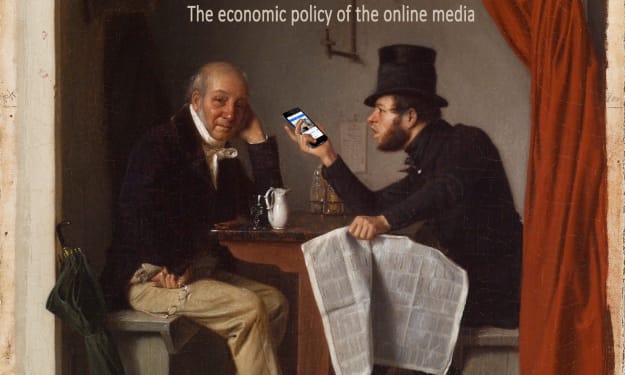
The Economic Policy of Online Media: Manufacture of Dissent
Peter Ayolov’s The Economic Policy of Online Media: Manufacture of Dissent is best read as a political economy of attention written from inside the contemporary media machine: a study of how dissent is not simply reported, represented, or ‘allowed’, but produced as a monetisable output of platform capitalism. The book’s organising intuition is both simple and unsettling. In the online environment, conflict is not a malfunction of communication; it is a business model. What appears to users as spontaneous outrage, grassroots polarisation, or organic ‘culture war’ is, at scale, a routinised industrial process—engineered through incentives, metrics, and infrastructures that reward emotional volatility and punish slow, careful public reasoning.
By Peter Ayolovabout a month ago in BookClub
Down Syndrome Picture Books with Uplifting Stories for Kids
Some of the most important lessons children learn don’t come from a lecture—they come from a story that makes them feel something. A character they root for. A family moment that feels familiar. A small problem that gets solved with love and patience. That’s why Down syndrome picture books matter so much: they help kids understand inclusion in the most natural way possible—through everyday life, friendship, and belonging.
By Shelley Smith Adamsabout a month ago in BookClub
When Success Isn’t Enough:
Joseph G. Motley did not write Unlocking Your Greatest You because he lacked discipline, opportunity, or ambition. He wrote it because he discovered that checking every box society hands out does not automatically lead to peace. Known as Coach Mot, Motley built a life many people strive for. He worked hard, provided for his family, and achieved professional stability. On paper, his story looked complete. Internally, it felt unfinished.
By Elisa Smithabout a month ago in BookClub