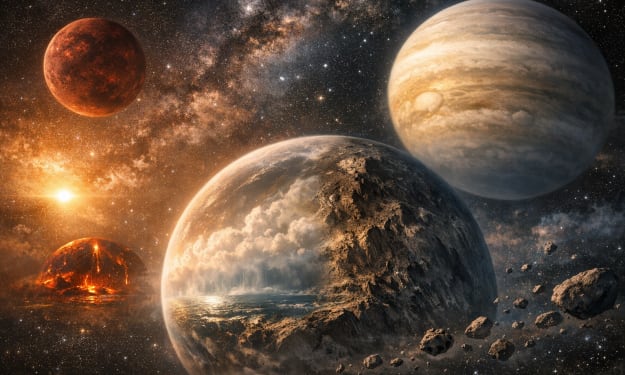
extraterrestrial
Speculation, theory, UFOs and Aliens. Are we alone in this universe or is there life outside Earth?
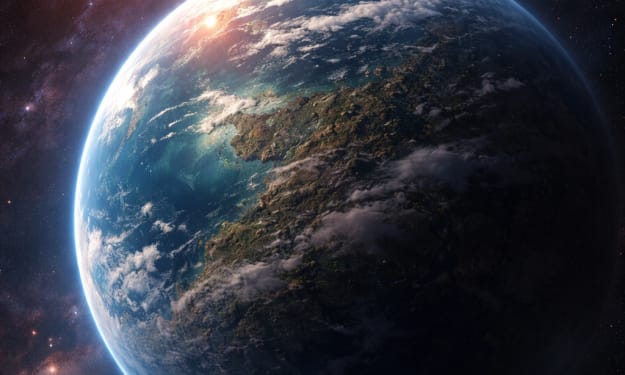
Exoplanets That Can Preserve Their Atmospheres for Billions of Years
When astronomers talk about potentially habitable worlds, the discussion often centers on surface temperature, liquid water, and orbital distance. Yet there is a more fundamental requirement that receives less public attention: atmospheric longevity. A planet may lie in the so-called habitable zone, but if it cannot retain its atmosphere over geological timescales, its prospects for long-term stability diminish dramatically.
By Holianyk Ihor15 days ago in Futurism
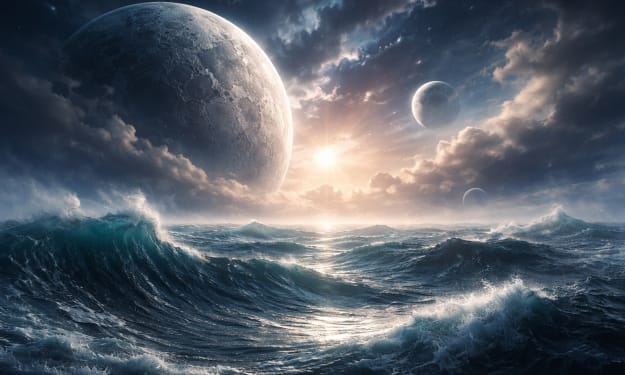
The Surprisingly High Abundance of Water Worlds
For years, water worlds were treated as an exotic possibility — scientifically plausible, but statistically rare. Planets dominated by deep global oceans, wrapped in thick atmospheres and layered with high-pressure ice, seemed like outliers in the cosmic inventory. The search for exoplanets focused primarily on “Earth-like” rocky worlds with thin atmospheres and moderate climates. However, as observational data have accumulated, a different picture has emerged. Water-rich planets may not be exceptional at all. They could be one of the most common planetary types in our galaxy.
By Holianyk Ihor15 days ago in Futurism
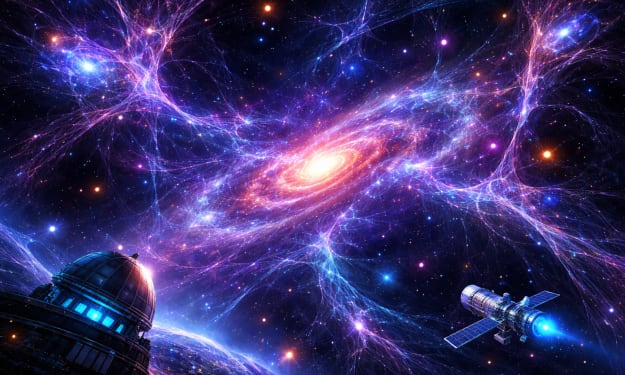
Unexpected Properties of Dark Matter Revealed in 2026
For decades, dark matter has remained one of the most persistent enigmas in modern astrophysics. Invisible to telescopes and undetectable through direct electromagnetic interaction, it nonetheless shapes the Universe on the largest scales. Galaxies rotate faster than their visible mass allows, galaxy clusters remain gravitationally bound, and the cosmic web itself depends on an unseen framework. Until recently, dark matter was largely treated as a silent, passive component—cold, inert, and interacting only through gravity. However, research published and analyzed in 2026 significantly challenged this simplified view.
By Holianyk Ihor16 days ago in Futurism
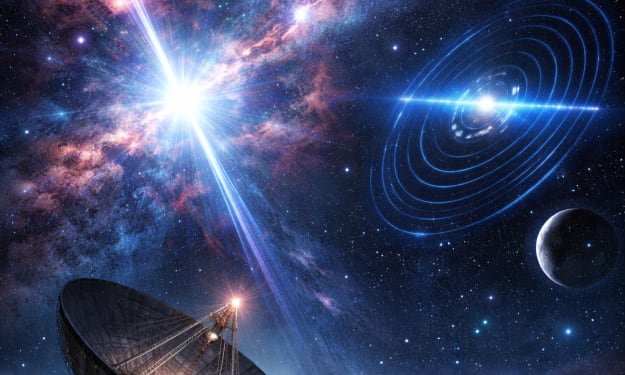
The Most Mysterious Signals from Deep Space Detected in 2026
The year 2026 has reinforced a long-standing truth in astronomy: the deeper we listen to the Universe, the stranger it becomes. Modern telescopes no longer simply observe distant stars and galaxies — they intercept brief, powerful, and often inexplicable signals that arrive from billions of light-years away. Some last only milliseconds, others pulse with eerie regularity, and a few originate from epochs when the Universe itself was still young.
By Holianyk Ihor16 days ago in Futurism
Exoplanets That Defy Classification — Even in Theory
In 1990s, many expected them to resemble familiar worlds: rocky planets like Earth, gas giants like Jupiter, or icy bodies similar to Neptune. The assumption was simple—different systems, same basic categories. Reality, however, turned out to be far more imaginative.
By Holianyk Ihor20 days ago in Futurism
Worlds with an Extremely Short Daylight Cycle
On Earth, the rhythm of life is deeply tied to a simple and familiar pattern: day follows night, night follows day, and one full cycle takes 24 hours. This steady cadence has shaped everything from human biology to global climate systems. But beyond our Solar System, this comforting regularity quickly breaks down. In the vast diversity of exoplanets discovered so far, astronomers have identified worlds where daylight lasts only a few hours—or even less. On such planets, the Sun barely rises before it sets again, and the very concept of a “day” becomes something alien.
By Holianyk Ihor20 days ago in Futurism
Exoplanets That Survived Planetary Collisions
When we imagine planets, we often think of calm, stable worlds tracing predictable paths around their stars for billions of years. But the reality of planetary systems—especially in their early stages—is far more violent. Young systems are chaotic environments where worlds migrate, gravitationally interact, and sometimes collide at unimaginable speeds. Remarkably, some exoplanets we observe today appear to have *survived* massive collisions with other planets, carrying the scars of ancient cosmic disasters.
By Holianyk Ihor21 days ago in Futurism
Worlds Where the Night Is Hotter Than the Day
On Earth, the rhythm of temperature feels intuitive. When the Sun rises, the ground warms. When darkness falls, heat slowly leaks back into space. Day means warmth; night means cooling. This pattern is so deeply ingrained in our everyday experience that it feels almost universal. Yet beyond the Solar System, astronomers have discovered worlds where this logic completely breaks down. On some distant planets, night is not a time of cooling at all. Instead, the darkness can be hotter than the blazing day.
By Holianyk Ihor21 days ago in Futurism
Why Some Exoplanets Look “Puffed Up”
When astronomers first began discovering exoplanets—planets orbiting stars beyond our Solar System—they expected familiar patterns. Some worlds would resemble rocky Earth-like planets, others would look like gas giants similar to Jupiter or Saturn. Instead, the universe delivered a surprise. Among thousands of known exoplanets, scientists found a strange class of worlds that appear abnormally large, swollen far beyond what their mass should allow. These planets look “puffed up,” like overheated balloons floating in space.
By Holianyk Ihor22 days ago in Futurism
Worlds on the Edge: Planets Nearly Torn Apart by Their Stars
In the vast diversity of planetary systems across the universe, some worlds exist in a state that seems almost impossible. These are planets that orbit so close to their parent stars that gravity itself threatens to tear them apart. They are not science fiction, nor distant theoretical curiosities. Astronomers have already discovered many such worlds, and they are among the most extreme objects ever observed beyond our Solar System.
By Holianyk Ihor22 days ago in Futurism
On Being First
The coffee shop is quiet today. It’s very pleasant. A few people drift in and out picking up their coffee to go while others sit, relax, and talk with muted voices. I must admit, it’s strange to be here this time of day. I’m usually in the dunes working.
By Om Prakash John Gilmore23 days ago in Futurism