panic attacks
Sudden periods of intense fear. But remember, you're not alone.
...And I'm Back!. Content Warning.
I missed this. I missed this site and this community and I really, really missed writing. My last post was 2 years ago. A lot has happened since then, personally and globally. I’m not an expert on the latter, but I can share with you parts of my story since I was last here.
By Tasha McIntosh15 days ago in Psyche
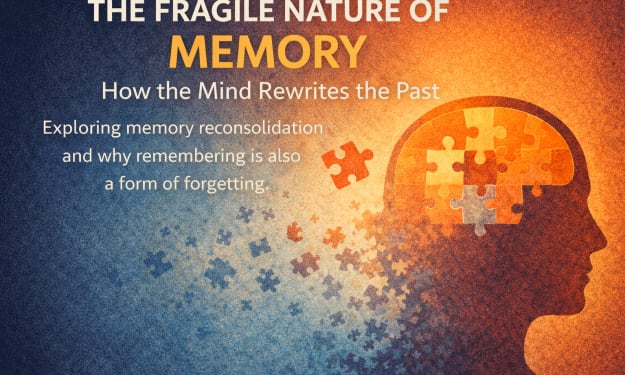
The Fragile Nature of Memory: How the Mind Rewrites the Past
We often view memory as a recording device. Something happens, and the brain stores it. Later, we recall it unchanged, like opening a file. Psychology presents a different picture. Memory is not fixed; it is fluid, reconstructive, and surprisingly fragile. One interesting aspect of cognitive psychology is memory reconsolidation, which is the process that alters our memories every time we recall them. This instability is not a flaw; it shows how our minds adapt, protect themselves, and reshape our identity over time.
By Kyle Butler18 days ago in Psyche
When Thinking Feels Like Action
There is a particular satisfaction that comes from understanding something clearly after wrestling with it for a long time. The mind settles. Tension releases. Pieces line up. In that moment, it can feel as though real movement has occurred, as though something meaningful has been accomplished. That feeling is not imagined. Cognitive resolution is a real event. The danger appears when that internal resolution is quietly mistaken for external change, and thinking begins to substitute for action rather than prepare the way for it.
By Peter Thwing - Host of the FST Podcast18 days ago in Psyche
The Best Friend of My Dreams Who Got Away
I met Nicole, the most treasured friend I have ever had in my life, at the Ronald McDonald House in Rochester, Minnesota while Nicole and I were admitted at the Mayo Clinic during the cold winter of February 2013. During those cold days she warmed my heart instantly when she approached me after our dinner had finished at the Ronald McDonald House. She broke the ice by saying “Hey, you just seem very nice and normal compared to a few here, and I’d like to get to know you.” I got that feeling you get when you feel like you’ve known that person forever instantaneously. Nicole asked me, “Do you know what POTS is?” which was her diagnosis, and for some reason, my mind went to pots and pans. Later that night when we went to our respective rooms with our parents and family, we continued to chat over text about our chronic health problems and how we dealt with them. I turned 18 during the 2 weeks our times overlapped at the Mayo Clinic; so, we were just 17 to 18-year-old teenagers who immediately had a crush on each other. We formed such a strong bond as best friends throughout our experience at Mayo’s that carried over into a complicated but beautiful friendship. Throughout the years, we did keep in touch and converse about our health battles and how we dreamed to overcome them.
By Eamon Janfada21 days ago in Psyche
Homework Assignment - Right, Wrong, or Grey-zone?
So my autism therapist gave me some homework for a new form (to me at least) of therapy. It is an Internal Family Systems parts mapping exercise and I have no idea if I am doing it correctly or not, but I just wanted to write about my experience... *smile*
By The Schizophrenic Mom22 days ago in Psyche
The Call You Don’t Remember Making. AI-Generated.
The phone rang at 3:11 a.m. Not a notification. Not an alarm. A real call. Omar stared at the screen through half-closed eyes. Unknown Number. He almost ignored it—almost—but something about the timing felt deliberate, like the call had waited for him to wake up before ringing.
By shakir hamid25 days ago in Psyche
Essence, Embodiment, and Relational Reality
The Failure of Reduction and the Need for Synthesis There is a persistent failure in many modern attempts to explain what a human being is. Some frameworks reduce the person entirely to matter, insisting that identity, consciousness, morality, and meaning are nothing more than emergent properties of physical processes. Other frameworks move in the opposite direction, detaching spirit from reason and grounding belief in intuition alone, often at the cost of coherence or accountability. Both approaches fail because both misunderstand essence. One denies that essence exists at all. The other treats it as something vague and undefinable.
By Peter Thwing - Host of the FST Podcastabout a month ago in Psyche