Latest Stories
Most recently published stories in Viva.
Trump’s Board of Peace Faces Global Skepticism as Major Powers Hold Back. AI-Generated.
When Donald Trump unveiled his new “Board of Peace,” he presented it as a bold corrective to what he has long described as a broken international system. Framed as a results-driven alternative to bureaucratic gridlock, the board promises fast-trackedreconstruction, streamlined diplomacy, anddecisiveleadership — particularly in conflict zones like Gaza. On paper, it sounds like a headline-ready solution to global paralysis. In practice, however, the world’s biggest powers appear tobewatching from a distance. So what exactly is this Board of Peace? Who’s on board — and why are so many influential countries keeping their seats empty? A New Player in Global Diplomacy The Board of Peace is designed as an international coordinating body focused on post-conflict stabilization and reconstruction. Its initial emphasis has been Gaza, where rebuilding infrastructure, restoring governance,andmanaginghumanitarianaidremainmassiveundertakings. Trump has positioned the board as leaner and more action-oriented than traditional institutions. Instead of prolonged negotiations and overlapping committees, the pitch centers on speed and centralized leadership. The United States has pledged substantial funding, signaling that Washington intends to be the driving force. Supporters argue that large multilateral organizations often move too slowly to respond to crises. In their view, a smaller coalition ofwilling nations could deploy funds and expertise more efficiently. Critics, however, see something else: a parallel structure that risks duplicating — or undermining — long-established global institutions. Who Signed On? The Board of Peace has attracted participation from a mix of mid-sized and regional powers. Several Gulf states have shown interest, particularly those with strategic and financial stakes in Middle Eastern stability. Some countries in Central Asia, North Africa, and Latin America have also signaled support. For these governments, joining may offer practical benefits. Participation could mean influence over reconstruction contracts, a stronger diplomatic relationship with Washington, or a seat at a new decision-making table. In some cases, alignment with the initiativereflectspragmaticgeopolitics. Smaller or emergingeconomies often welcome platforms that diversify their partnerships beyond traditional Western-led frameworks. But while the roster includes dozens of countries, it notably lacks some of the world’s heaviest hitters. The Bigger Countries’ Caution Major European powers have largely refrained from fullmembership. Nations like France, Germany, and the United Kingdom have opted for caution, citing concerns about governance structures and institutional overlap. China and India — both key global players with growing influence in multilateral affairs — have not embraced the initiative either. Their hesitation signals that the board may struggle to achieve the universal legitimacy that established global bodies enjoy. Why the reluctance? There are several factors at play. 1. Institutional Competition Many governments are wary of initiatives that appear to sidestep or dilute existing systems, particularly the United Nations framework. Even if the Board of Peace operates alongside established institutions, its existence raises questions about coordination and authority. Will decisions be harmonized with U.N. agencies? Who ultimately sets the agenda? How are disputes resolved? Without clear answers, larger countries may prefer to stay within structures they helped shape and understand. 2. Governance and Control Leadership matters in international diplomacy — not just who leads, but how. The Board of Peace is closely associated with Trump personally. While supporters see decisive leadership as a strength, skeptics question whether centralized control could overshadow collaborative governance. Major powers often seek balanced structures where influence is distributed. If they perceive decision-making authority to be concentrated, they may hesitate to commit funding and political capital. 3. Financial Commitments Membership reportedly comes with funding expectations. For larger economies, contributions could be substantial. In an era of domestic budget pressures and shifting political priorities, governments are cautious about signing blank checks. They want clarity on oversight, accountability, and measurable outcomes before pledging major resources. 4. Geopolitical Signaling Joining a new diplomatic body is never purely administrative — it’s symbolic. Participation may be interpreted as endorsement of a particular political vision. Some governments may wish to avoid appearing aligned with an initiative that could be seen as partisan or polarizing. Global diplomacy often involves careful balancing acts. Sitting out can be as strategic as signing on. The Gaza Focus — and Beyond The board’s immediate emphasis on Gaza reconstruction gives it a defined mission. Rebuilding housing, restoring utilities, and supporting governance structures are tangible goals. Yet there are broader ambitions as well. Proponents have suggested that the Board of Peace could expand into other regions, serving as a template for post-conflict recovery worldwide. That expansion potential is both a selling point and a sticking point. For supporters, scalability means impact. For skeptics, it raises the question: is this a complementary initiative, or a new pillar of global governance? The answer may determine whether more countries eventually participate. A Test of Influence At its core, the Board of Peace is a test — not just of funding or logistics, but of influence. Can a U.S.-led initiative attract enough international buy-in to become durable? Can it deliver measurable results quickly enough to justify its creation? And perhaps most importantly, can it operate without deepening fractures in an already fragmented global order? History shows that new institutions often face resistance at first. Some fade away quietly. Others evolve into fixtures of international cooperation. The difference usually lies in outcomes. The Road Ahead For now, the Board of Peace exists in a gray zone — neither universally embraced nor outright rejected. Its supporters see momentum and opportunity. Its critics see ambiguity and risk. If the board succeeds in delivering visible improvements in Gaza — faster rebuilding, transparent governance, effective aid distribution — skepticism may soften. Concrete results have a way of shifting diplomatic calculations. If, however, coordination falters or political disputes overshadow progress, larger countries may feel vindicated in their caution. In global politics, legitimacy is earned through performance as much as participation. A Changing Diplomatic Landscape The emergence of the Board of Peace reflects a broader reality: international governance is evolving. Traditional institutions face growing criticism for inefficiency and political deadlock. At the same time, new coalitions and regional groupings are experimenting with alternative models. Whether Trump’s initiative becomes a lasting fixture or a brief experiment will depend on execution, transparency, and inclusivity. For now, the board stands as a symbol of a shifting diplomatic landscape — one where leadership, speed, and visibility compete with tradition, consensus, and institutional depth. The bigger countries may be steering clear for the moment. But in global affairs, distance rarely means disinterest.
By 😎Baلoch✨.zada😎6 days ago in Viva
Why Phuket Continues to Lead Thailand’s Nightlife Scene
Thailand is one of the most visited countries in the world, with tons of activities, amazing food, as well as an active nightlife. One of its islands, Phuket, has become known for nights that feel lively without having to do anything extra. Music, food, conversation, and movement are all part of the evenings. Phuket’s nightlife stands out because it has a plethora of ways to enjoy the night without asking visitors to follow a single script.
By Claudia Fennel6 days ago in Viva
Causes, Symptoms and Treatment Options for Facial Hair in Women. AI-Generated.
First, take a deep breath. If you’ve noticed chin hairs or extra facial hair, you are not alone. Many women experience this at some point in life. A few stray hairs are completely normal. But if the hair growth feels excessive, sudden, or unusual, it’s important to understand what your body might be signaling.
By Veronica Bennett6 days ago in Viva
Why River Cruises Are Consistently Recognised as a Distinctive Chiang Mai Experience
Chiang Mai developed beside the Mae Ping River, which shaped how people moved, traded, and settled across the region long before railways and highways appeared. The river flows through quieter parts of the city, past houses, small gardens, and working stretches of riverbank. Moving along this section shows a side of Chiang Mai shaped by daily use and the land itself – here's how.
By ameliarosanna6 days ago in Viva
What Are the Unwritten Rules in Dubai’s Public Spaces
Although Dubai is undoubtedly a modern and fairly progressive city, it is important to remember that it still inherits a rather conservative Muslim culture. Although there are many engrossing things to do in this metropolis – such as visiting the sightseeing attractions, experiencing the rich heritage, shopping in the malls and souks, and enjoying the nightlife – you must always take care to respect the local laws and traditions. Some useful cultural guidelines for visitors to Dubai are provided below.
By ameliarosanna6 days ago in Viva
Why I'm Using Secret Military Survival Rituals to Fix Burned-Out CEO's
The Frequency of Survival: Why I Don’t Care About Your Squat PR I’m an anti-talent for business. Let’s just start there. I don’t have a marketing funnel, my Instagram is a disaster, and for years, my "price list" was basically whatever my gut told me was right in the moment. If you’d told me thirty years ago, while I was clutching a rifle in a frozen Croatian trench, that I’d spend my fifties gently rubbing the forehead of some high-powered executive who’s on the verge of tears from exhaustion. I’d have thought you were shell-shocked.
By Feliks Karić6 days ago in Viva
The Infinite Sparkle: Why the Women’s Diamond Engagement Band Represents Modern Commitment
In the landscape of romance, symbols evolve. For a long time, the size of a diamond was seen as a direct reflection of a partner's success or the depth of their devotion. But as we navigate through 2026, the narrative is changing. Today’s British bride is looking for something more intimate, more wearable, and more symbolic. This shift has placed the women’s diamond engagement band at the very heart of modern proposals.
By Mohd Kaish7 days ago in Viva
Why Dubai Leads the Way in Hotel Innovation
Among the emirates of the United Arab Emirates region, Dubai is probably the most well-known when it comes to a lot of things, including hospitality. While the process didn’t happen overnight, Dubai has grown into one of the world’s most exciting hospitality destinations, attracting professionals who want to learn, grow, and build strong careers. With luxury hotels, diverse cultures, and fast development, the city creates the perfect environment where new ideas are born. This article explores why Dubai continues to attract hospitality talent and how innovation shapes its future as a leader in tourism on a global scale.
By ameliarosanna7 days ago in Viva
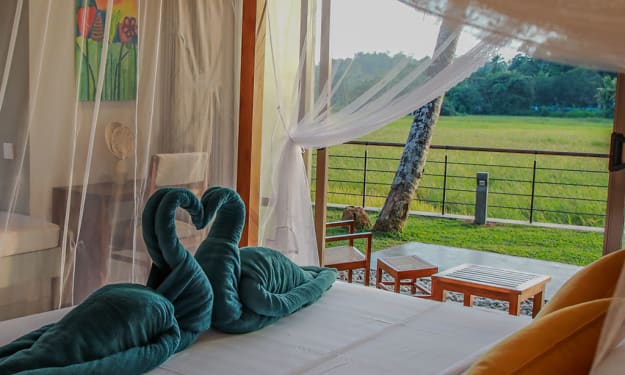
What Is a True Eco Villa?
As sustainability becomes a defining value across the world, the tourism industry has steadily adapted to meet the expectations of more conscious travellers. Rather than being left behind, travel has embraced eco-friendly practices that balance environmental responsibility with comfort and quality. This evolution has led to the rise of eco-tourism, where thoughtful design, nature, and authenticity come together to create meaningful travel experiences.
By Aurora Gianna7 days ago in Viva
Why Sandton Is Johannesburg’s Premier Business District and the Next Best Place for Your Conference or Retreat
Sandton has evolved into far more than a suburb of Johannesburg. It is the financial and corporate heartbeat of modern South Africa, a place where boardroom decisions ripple across the continent. For organisations seeking a destination that balances commercial credibility with comfort and sophistication, Sandton delivers with precision. Located within Johannesburg, Sandton represents a forward-facing Africa that is globally connected, professionally efficient, and increasingly attractive for high-level conferences and corporate retreats.
By Claudia Fennel9 days ago in Viva